
Exercise Is Information
Beyond Cardiovascular Fitness: How Muscle Contraction Coordinates the Nervous System, the Microbiome, and the Body Clock

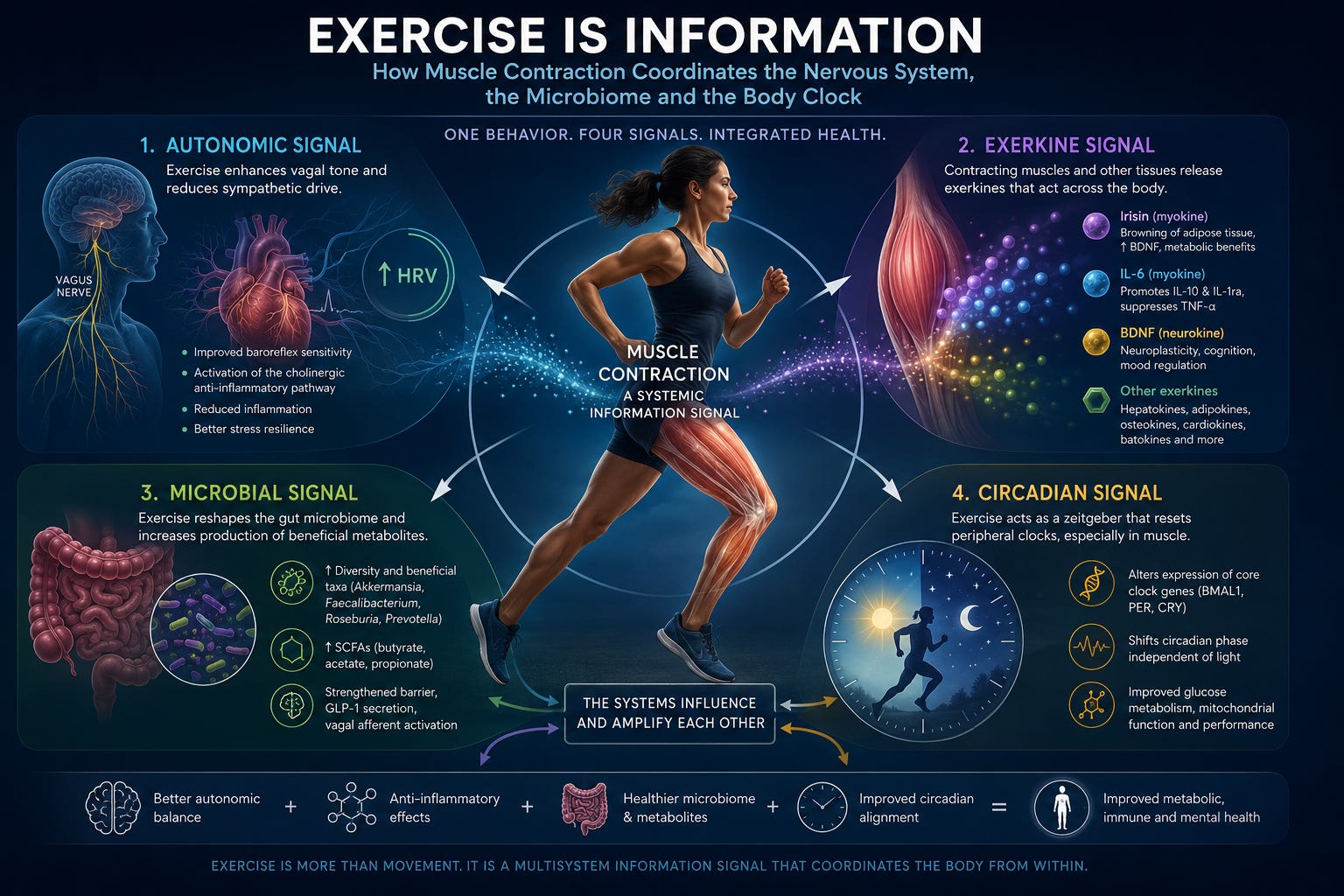
Ask most clinicians what exercise does, and the answers will be predictable. It lowers blood pressure, improves insulin sensitivity, reduces cardiovascular risk, preserves muscle mass, and extends the lifespan. All these statements are true. However, they describe outcomes rather than mechanisms.
For decades, exercise physiology has been largely framed through a cardiovascular and metabolic lens. Physical activity was viewed as an energetic demand placed on the skeletal muscle, heart, and respiratory system. While this model remains useful, modern physiology suggests a far deeper story.
Exercise is increasingly understood not simply as a means of expending energy but as a complex biological signal that coordinates communication across multiple organ systems simultaneously.
Every movement session generates a cascade of molecular, neural, microbial, and circadian signals. These signals influence the autonomic nervous system, immune function, endocrine communication, gut ecology, and cellular timing mechanisms throughout the body. Rather than acting independently, these systems continuously interact, amplifying and modifying each other.
In this sense, exercise belongs to the same category as light exposure, feeding, and temperature. It is not merely a movement. It is information.
A morning walk, an afternoon resistance session, or a vigorous run each deliver a physiological message that helps the body decide how to allocate resources, regulate inflammation, organise metabolism, and synchronise biological rhythms. Remarkably, exercise affects many systems. Remarkably, it affects all of them simultaneously.
Exercise Remodels the Autonomic Nervous System
One of the most consistent adaptations to regular physical activity is the shift in autonomic balance. Aerobic training increases parasympathetic activity while reducing excessive sympathetic drive. Clinically, this appears as a lower resting heart rate and improved heart rate variability (HRV); however, these visible changes reflect much deeper neural adaptations.
Exercise enhances baroreflex sensitivity, improves cardiovascular responsiveness, and alters central autonomic regulation, making the body more resilient to physiological and psychological stress. Rather than simply helping people "relax”, regular training changes the neural circuitry that determines how stress is processed and regulated.
This autonomic adaptation has important implications for the immune function. Reduced vagal activity has been associated with higher concentrations of inflammatory cytokines in conditions ranging from depression and anxiety disorders to diabetes and chronic stress. Consequently, HRV is increasingly viewed not merely as a marker of autonomic health but as a practical window into the body's broader inflammatory status.
The biological mechanism is increasingly well-characterised. Efferent vagal signalling activates what is known as the cholinergic anti-inflammatory pathway, suppressing macrophage production of pro-inflammatory cytokines, such as tumour necrosis factor-alpha (TNF-α). This pathway has attracted significant clinical interest, leading to the development of vagal nerve stimulation therapies for inflammatory bowel disease, rheumatoid arthritis, and metabolic diseases.
Exercise appears to naturally engage many of these mechanisms.
Recent research has introduced a subtle but important refinement. Historically, the vagus nerve has been viewed as a regulator of inflammation. It is now increasingly recognised that the relationship works in both directions. Chronic inflammation, particularly in the gastrointestinal tract, may impair vagal afferent signalling, thereby weakening one of the body's most important anti-inflammatory feedback systems.
This creates the potential for a vicious cycle: inflammation impairs vagal signalling, and impaired vagal signalling allows inflammation to persist, reinforcing the cycle over time. Exercise may interrupt this process by simultaneously reducing the inflammatory burden and restoring autonomic function.
Skeletal Muscle as an Endocrine Organ
Muscle contraction generates more force and consumes more ATP.
When skeletal muscle contracts, it becomes a powerful endocrine organ, releasing a diverse array of signalling molecules that communicate with distant tissues throughout the body. This discovery has transformed our understanding of why exercise influences organs that are not directly involved in movement.
These signalling molecules are collectively known as exerkines. This term encompasses a broad family of peptides, metabolites, lipids, extracellular vesicles, and nucleic acids released in response to physical activity.
Importantly, not all exerkines originate in the muscles. Myokines represent only the skeletal muscle component of a much larger communication network. Adipose tissue releases adipokines, the liver releases hepatokines, bone contributes osteokines, brown adipose tissue produces batokines, the heart secretes cardiokines, and the nervous system generates neurokines. Together, these molecules form an integrated exercise-responsive signalling system.
This distinction is important because some of the most important exercise-induced adaptations arise from communication between tissues rather than from muscles alone.
Among the best-studied examples is irisin, a molecule generated by the cleavage of FNDC5. Irisin promotes the browning of white adipose tissue, enhances metabolic flexibility, and appears capable of crossing the blood-brain barrier, where it may contribute to the increased expression of brain-derived neurotrophic factor (BDNF) and support neuroplasticity.
Interleukin-6 is another example of context-dependent biology. In chronic diseases, elevated IL-6 levels are often interpreted as markers of inflammation. However, during exercise, IL-6 behaves differently. Acute exercise-induced IL-6 promotes anti-inflammatory mediators such as IL-10 and the IL-1 receptor antagonist while suppressing TNF-α production. Therefore, the same molecule can participate in both inflammation and inflammation resolution, depending on its biological context.
BDNF occupies a particularly interesting position in this network. Although exercise increases circulating BDNF concentrations, most of its neurological effects appear to arise from direct neuronal production and release. The brain does not merely respond to exercise; it actively participates in generating its own adaptive response.
As evidence accumulates, the emerging picture is that exerkines function less like isolated hormones and more like components of a coordinated communication system. Their release depends on exercise intensity, duration, modality, and training. Not all exercises produce identical biological messages, and understanding these differences may become increasingly important in clinical exercise prescription.
The Gut Interprets the Exercise Signal
The gut microbiome is often described as being influenced by exercise.
A more accurate description may be that the microbiome interprets the exercise.
Physical activity consistently alters the microbial composition, favouring organisms associated with metabolic health, epithelial integrity, and short-chain fatty acid production. While individual responses vary considerably, studies have repeatedly identified increased abundance of genera such as Akkermansia, Faecalibacterium, Roseburia, and Prevotella among physically active individuals.
The significance of these changes lies not primarily in which organisms become more abundant but in what they produce.
Short-chain fatty acids, particularly butyrate, acetate, and propionate, are important signalling molecules in the gut-brain-metabolic axis. They influence epithelial health, glucose regulation, incretin release, immune function, and vagal afferent activities. In many respects, they become the biochemical currency through which microbial adaptations communicate with their hosts.
Thus, exercise and the microbiome participate in a dynamic feedback loop.
Exercise enhances the vagal activity. Increased vagal signalling influences gastrointestinal motility and barrier function. Improved barrier integrity alters the gut environment and shapes the microbial ecology. Microbial metabolites then feed back through enteroendocrine pathways and vagal afferents to influence autonomic regulation, inflammation, and energy homeostasis in the host.
Each component reinforces the other.
However, like many biological systems, this relationship follows a hormetic curve. Moderate exercise tends to enhance gastrointestinal health, whereas extreme endurance exercise, particularly when combined with inadequate nutritional intake, can transiently increase intestinal permeability and provoke inflammatory responses. More is not always better in this context. The physiological response depends on the dose.
Exercise Also Resets Time
Perhaps the most underappreciated function of exercise is its role as a biological timing signal in the circadian clock.
Every cell in the body contains a molecular clock governed by transcriptional feedback loops involving genes such as BMAL1, CLOCK, PER, and CRY. Although the suprachiasmatic nucleus within the hypothalamus remains the body's master clock and is primarily synchronised by light, peripheral tissues respond to additional timing cues.
Exercise is one of the most powerful cues.
The skeletal muscle appears to be particularly responsive to exercise-induced timing signals. Experimental models have demonstrated that scheduled exercise can shift the circadian phase independently of light exposure. Human studies have increasingly shown that exercise performed at different times of the day influences clock gene expression, metabolic responses, and physiological adaptation.
In chronobiology, a stimulus capable of synchronising biological rhythms is known as a zeitgeber, or "time giver." Exercise clearly belongs to this category.
This has important clinical implications because circadian timing influences mitochondrial function, glucose regulation, protein synthesis, immune response, and tissue repair. The body's response to exercise is not constant throughout the day. The same training session performed at different times may generate subtly different physiological outcomes.
An emerging body of research suggests that strategically timed exercise may improve glycaemic control, support metabolic health, and help resynchronise disrupted peripheral clocks. This possibility is particularly relevant for individuals experiencing circadian misalignment, including shift workers and those with chronic sleep disruptions.
Although the evidence has not yet matured into universal prescriptions, patterns are emerging. Resistance training often aligns with periods of peak neuromuscular performance later in the day, whereas other exercise modalities may exert different chronobiological effects depending on the timing.
The question is gradually evolving from How much exercise should we perform? To how much, what type, and when?
One Behaviour, Four Biological Systems
The traditional cardiovascular exercise model is not incorrect.
This is simply incomplete.
Each movement generates multiple streams of biological information. Exercise remodels autonomic function, releases exerkines that coordinate communication between organs, reshapes microbial activity within the gut, and synchronises peripheral circadian clocks.
None of these systems operate in isolation.
Improved vagal tone supports the integrity of the gut barrier. The microbiome produces metabolites that influence neural signalling and metabolic regulation. Exerkines shape immune, neurological, and metabolic adaptations. Circadian timing determines the magnitude and nature of these responses.
The body does not interpret exercise as a single event or process.
It interprets this as a coordinated message.
A neural message.
An endocrine message.
A microbial message.
A circadian message.
This may be the most useful way to think about exercise in 2026. Not as a strategy for burning calories or simply strengthening muscles, but as one of the body's most powerful regulatory inputs, a signal capable of synchronising multiple physiological systems through a single behavioural act.
The future of exercise science may not be about discovering whether movements are beneficial. We already know that.
A more interesting question is how precisely we can use exercise as information.
References
Bautista, J., Ojeda-Mosquera, S., Ordóñez-Lozada, D., & López-Cortés, A. (2025). Peripheral clocks and systemic zeitgeber interactions: From molecular mechanisms to circadian precision medicine. Frontiers in Endocrinology, 16, Article 1606242. https://doi.org/10.3389/fendo.2025.1606242
Hunter, A. L., & Bechtold, D. A. (2025). The metabolic significance of peripheral tissue clocks. Communications Biology, 8, Article 497. https://doi.org/10.1038/s42003-025-07932-0
Jameson, K. G., et al. (2024). Select microbial metabolites in the small intestinal lumen regulates vagal activity via receptor-mediated signaling. iScience, 27(1), Article 111699. https://doi.org/10.1016/j.isci.2024.111699
Mukhopadhya, I., & Louis, P. (2025). Gut microbiota-derived short-chain fatty acids and their role in human health and disease. Nature Reviews Microbiology, 23(10), 635–651. https://doi.org/10.1038/s41579-025-01183-w
Ohara, T. E., & Hsiao, E. Y. (2025). Microbiota–neuroepithelial signalling across the gut–brain axis. Nature Reviews Microbiology, 23(6), 371–384. https://doi.org/10.1038/s41579-024-01136-9
Phelps, C. M., & Meisel, M. (2026). The immunology of exercise: Mechanisms, mediators, and therapeutic opportunities. Immunity. Advance online publication. https://doi.org/10.1016/j.immuni.2026.04.016
Varghese, S., Rao, S., Khattak, A., Zamir, F., & Chaari, A. (2024). Physical exercise and the gut microbiome: A bidirectional relationship influencing health and performance. Nutrients, 16(21), Article 3663. https://doi.org/10.3390/nu16213663
Walzik, D., Wences Chirino, T. Y., Zimmer, P., et al. (2024). Molecular insights of exercise therapy in disease prevention and treatment. Signal Transduction and Targeted Therapy, 9, Article 138. https://doi.org/10.1038/s41392-024-01841-0
I really like this perspective. Thinking of exercise as biological information, not just energy expenditure, helps explain why the right type of movement can influence so many systems beyond muscle, from metabolism to brain health. The challenge now is translating these molecular insights into truly personalized exercise prescriptions.
Great write-up. Rather than simply burning calories, exercise acts as a powerful signal that communicates with virtually every organ system, influencing gene expression, mitochondrial function, insulin sensitivity, immune regulation, and the release of myokines that help coordinate whole-body adaptation.
As a physician-scientist, I think it’s important for us to remind ourselves that the body’s response to exercise depends on the type, intensity, frequency, and recovery. Different forms of movement provide distinct physiological signals; resistance training promotes muscle strength and bone health, aerobic exercise enhances cardiovascular and mitochondrial function, and regular daily movement supports overall metabolic health. A balanced, individualized approach is more beneficial than relying on any single exercise modality.
Really thought-provoking perspective. Perhaps one of the most remarkable aspects of exercise is that it serves as information for the body, continuously signaling tissues to adapt, repair, and become more resilient. Thanks for sharing this insightful overview